
Safe Banking
Fake Traffic Challan Scam: How It Works & How to Protect Yourself
3 min read
•
Feb 17, 2026

Fake traffic challan scams have surged across India, with cybercriminals exploiting fear, urgency, and official‑looking messages to trick people into paying bogus fines. Recent cases show losses ranging from a few hundred rupees to several lakhs. This SEO‑friendly guide explains how these scams operate, the warning signs, and the safest ways to check and pay challans.
What Is the Fake Traffic Challan Scam?
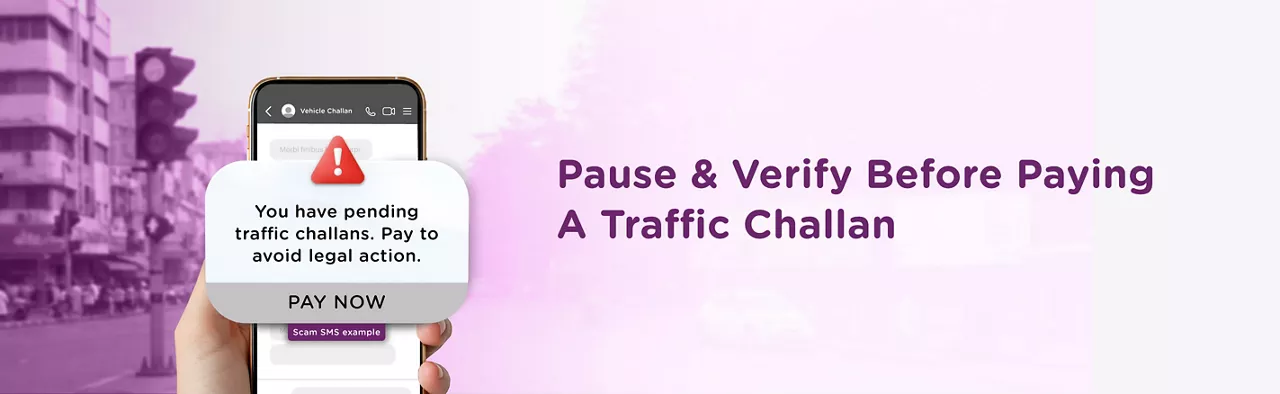
The scam involves fraudsters sending SMS, WhatsApp messages, or emails claiming you have a pending traffic fine. These messages include malicious payment links designed to steal your bank or card details.
Such fraudulent messages are crafted to mimic official government notices and lure victims into clicking immediately.
In multiple reported cases, people clicked on these links only to face large unauthorized international transactions. For example, a Delhi resident recently lost over ₹2.49 lakh after attempting to pay a “₹500 pending challan” via a fake link.
How the Scam Operates
Cybercriminals use several tactics to make their messages seem legitimate:
1. Fake SMS/WhatsApp Alerts
Messages often claim:
- “Pending challan detected”
- “Pay immediately to avoid license suspension”
- “Court notice issued for non‑payment”
These alerts often come from regular 10‑digit mobile numbers, not verified sender IDs.
2. Fraudulent Payment Links
The URLs mimic official government portals but redirect you to phishing sites designed to steal data.
Many fake domains closely resemble the Parivahan website and use shortened URLs.
Security researchers have also found 36+ fake domains impersonating RTO e‑Challan sites.
3. Browser‑Based Phishing Pages
Unlike older scams involving malware, cybercriminals now use cloned government portals that:
- Display fake violation details
- Look identical to real Parivahan pages
- Accept card‑only payments (a major red flag)
4. Data Theft
Once victims enter:
- Card number
- CVV
- Expiry date
…the attackers harvest this information and initiate unauthorized transactions.
How to Identify a Fake Traffic Challan Message
1. Check the Website URL
- Official domains end with .gov.in (e.g., parivahan.gov.in)
- Fake domains may end in .in, .com, .online, or .net
If the URL doesn’t end with .gov.in, it’s fake.
2. Look for Verified Sender IDs
Genuine challan messages come from IDs like:
- VK‑VAAHAN
- AD‑TRAFIC
Fake messages come from random mobile numbers.
3. Suspicious Language
Fake messages use:
- Threatening tone (“Arrest warrant issued”)
- Urgent calls to action
Real government notices use formal, neutral language.
4. Payment Method Restrictions
If the page allows card‑only payments and disables UPI/net banking, it’s likely fraud.
Scammers want your card details.
5. Missing Details
Fake challans often lack:
- Challan number
- Vehicle details
- Offense location
How to Safely Check Your Challan
Use only official government portals:
- Parivahan: https://echallan.parivahan.gov.in
- State Traffic Police Websites
Steps to verify:
- Type the URL manually in your browser (never click links in messages).
- Go to “Check Challan Status.”
- Enter the vehicle number + last 5 digits of the chassis/engine number.
If the system shows “No Challan Found,” the message was fake.
What to Do If You Already Clicked a Fake Link
Act within the Golden Hour (first 60 minutes) to minimize loss.
Immediate steps:
- Call 1930 – National Cyber Crime Helpline.
- Inform your bank and block your credit/debit card.
- Report the incident on the official cybercrime portal.
- Keep screenshots, messages, and transaction details for police reports.
Safety Tips to Avoid Fake Challan Scams
- Never click payment links from SMS or WhatsApp.
- Always check URLs ending with .gov.in.
- Do not share OTP, CVV, or card details with anyone.
- Enable transaction alerts on your bank accounts.
- Educate family members, especially senior citizens.
Conclusion
The fake traffic challan scam is becoming more sophisticated, using fear and official‑looking communication to exploit unsuspecting citizens. Staying alert, verifying every message, and using only official government websites for payments can protect you from major financial losses.
If you found this guide helpful, share it to protect others from this rapidly growing fraud.
Frequently Asked Questions
1. Can real traffic police send challans through WhatsApp?
Yes, some states have started WhatsApp‑based notifications — which scammers misuse by imitating them. Always verify on the official Parivahan website before paying.
2. What should I do if the fake challan link automatically opens?
Immediately close the page, clear your browser history, and avoid entering any details.
If you accidentally filled in card information, call 1930 and block your card.
3. Will the real traffic police ever threaten arrest or license suspension through SMS?
No. Genuine traffic departments don’t use threatening language.
Official notices are formal and come from verified sender IDs.
4. Are there any apps to check real traffic challans?
Yes, you can use:
- mParivahan app
- State-specific traffic police apps
Avoid searching “challan check” on Google because scam sites buy ads to appear on top.
5. Can scammers steal money if I only clicked the link but didn’t enter details?
Usually no — clicking alone doesn’t cause loss.
But scammers might use:
- Browser phishing
- Session hijacking
- Repeated popups to trick you
Stay cautious and monitor your bank SMS alerts.

People with similar interests also read: