
Credit Card
What is a BIN (Bank Identification Number)? Meaning, Structure and How It Works
2 min read
•
Jul 15, 2026

Table of contents
Every time you swipe a card, tap to pay or enter your card details online, a six-or-eight digit code at the start of the card number does most of the heavy lifting in the background. That code is the BIN. Merchants use it to decide which payment network to route the transaction through. Banks use it to identify the issuer. Anti-fraud systems use it to verify the transaction makes sense. Understanding what a BIN is helps a customer, a merchant and a business owner alike.
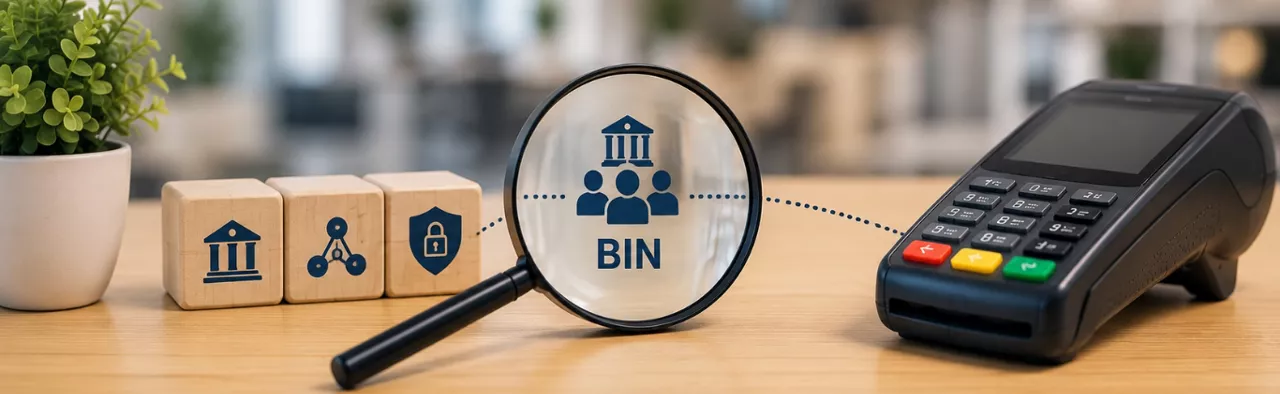
A BIN, or Bank Identification Number, is the first 6 or 8 digits of a payment card number that identifies the card-issuing institution, the card network (Visa, Mastercard, RuPay, American Express) and the card type (credit card, debit card, prepaid card). The BIN is the routing key for the entire card payment ecosystem. It is governed by the ISO/IEC 7812 standard.
What is a BIN in simple terms?
A BIN Bank Identification Number is the first 6 or 8 digits printed on every payment card, used to identify the bank or institution that issued the card and the network on which the card is run.
Why is a BIN important?
It tells the payment processor everything needed to route the transaction: which bank issued the card, what network it runs on, what type of card it is, and what country it was issued in. Without the BIN, the payment system cannot send the authorisation request to the right place.
How is a BIN structured?
Position | What it means |
1st digit | Major industry identifier tells you the type of issuer (banking, retail, airline, etc.). |
Digits 2–6 (or 2–8) | Specific bank or institution that issued the card. |
Digits after 6/8 | Account identifier unique to the cardholder. |
Last digit | Luhn check digit validates the card number is mathematically correct. |
What is the difference between a BIN and an IIN?
BIN (Bank Identification Number) and IIN (Issuer Identification Number) refer to the same code. The card networks moved to the term IIN as cards expanded beyond banks (retail, fintech, prepaid). Both are used interchangeably in industry literature.
How do merchants use the BIN?
Merchants use the BIN to route the transaction to the right network, identify whether the card is debit or credit, decide which loyalty programme applies, and run early fraud checks (does the BIN match the billing country, is the BIN known for high chargebacks, etc.).
How is the BIN used in fraud prevention?
Fraud-prevention engines check whether the BIN’s country of issue matches the billing address country, whether the BIN is on watchlists, and whether the BIN’s typical transaction pattern matches the current transaction. A mismatch triggers additional authentication or a decline.
What is BIN lookup?
A BIN lookup is a service usually an API that takes a card BIN and returns information about it: issuer name, country, card type, network, and prepaid/credit/debit classification. Merchants and fraud teams use BIN lookup as a real-time decision input.
Conclusion
The BIN is small in size but central to the payment system. It tells the processor where to send the transaction, the merchant which card type they are dealing with, and the fraud engine whether the transaction looks legitimate. Understanding it removes one of the bigger black boxes in everyday card payments.
Frequently asked questions
Q. What does BIN stand for?
BIN stands for Bank Identification Number. It is the first 6 or 8 digits of a payment card number.
Q. Is a BIN the same as a card number?
No. The BIN is the first 6 or 8 digits of the card number. The full card number (PAN) is typically 16 digits and includes the BIN, the account identifier and a Luhn check digit.
Q. Can a BIN reveal personal information?
No. A BIN reveals only the issuer, network and card type. It does not reveal the cardholder’s identity or balance.
Q. Why are some BINs 6 digits and others 8?
The card networks moved from 6-digit BINs to 8-digit BINs to accommodate the growth in cards globally. New cards typically use 8-digit BINs; older ones still use 6.
Q. How can I find the BIN of my card?
It is the first 6 (or 8) digits printed on the front of your card.
Q. What is BIN attack?
A BIN attack is a fraud pattern where attackers use a known BIN and generate possible card numbers by varying the remaining digits, testing them on low-value transactions to find a valid card.
Q. How do merchants prevent BIN attacks?
By rate-limiting authorisation attempts per BIN, using fraud-detection engines, requiring CVV and 3-D Secure, and blocking BINs with abnormal failure patterns.
Q. What is the difference between BIN and IIN?
They refer to the same code. IIN is the newer ISO term; BIN is the older industry term used interchangeably.
Q. Can two cards have the same BIN?
Yes. The BIN identifies the issuer, not the cardholder. All cards from one issuer of the same type share the same BIN.
Disclaimer: This article is provided by AU Small Finance Bank for general information. Product features, charges, eligibility and procedures referenced are governed by AU Small Finance Bank policy and applicable RBI / regulatory guidelines, and are subject to change without notice. Please refer to www.au.bank.in for the latest product terms.

People with similar interests also read: