
Loans
Benefits of Personal Loans Over Salary Advances
3 min read
•
Aug 13, 2026

Introduction
When an unexpected expense comes up before your next payday, two common options come to mind: a salary advance or a personal loan. Both give you quick access to funds, but they're built very differently and for most financial needs beyond a small, short-term gap, a personal loan tends to offer more value. Here's a closer look at how the two compare and why a personal loan is often the smarter choice.
What Is a Salary Advance?
A salary advance is a short-term facility, usually offered by an employer or a lending app, that lets you access a portion of your upcoming salary before payday. It's typically capped at a multiple of your monthly salary, must be repaid within 3 to 12 months, and often carries a fixed processing fee along with a relatively high effective interest cost.
What Is a Personal Loan?
A personal loan is an unsecured loan offered by banks or NBFCs that can be used for virtually any purpose medical expenses, travel, home renovation, debt consolidation, or a wedding. It typically offers a larger loan amount, a longer repayment tenure ranging from one to seven years, and structured EMIs.
Benefits of Personal Loans Over Salary Advances
1. Higher Loan Amounts
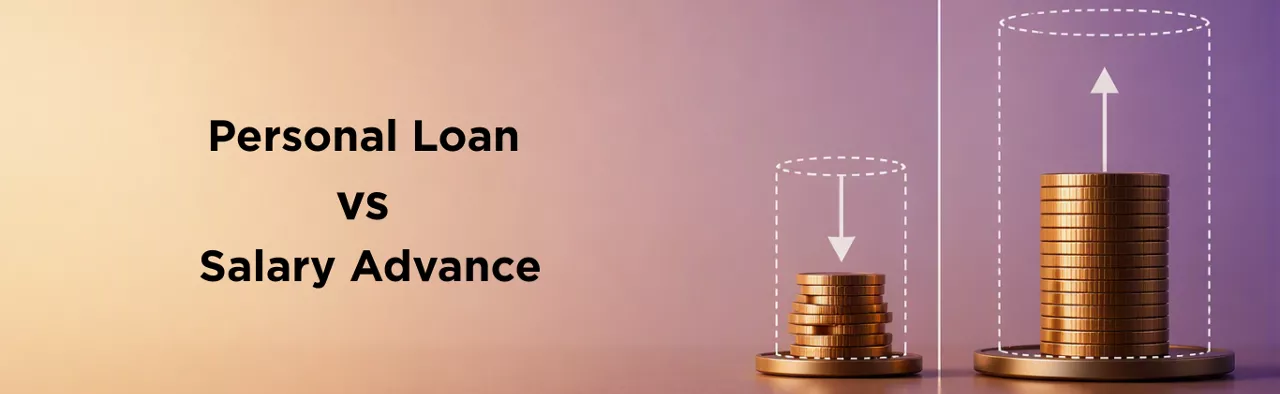
Personal loans generally allow you to borrow significantly more than a salary advance, which is usually capped at a portion of your monthly salary. This makes personal loans far more suitable for larger expenses like medical emergencies, home repairs, or debt consolidation.
2. Longer, More Flexible Repayment Tenure
While a salary advance typically needs to be repaid within weeks or a few months, a personal loan can be repaid over one to seven years. This spreads the repayment burden across smaller, more manageable EMIs rather than one large deduction from your next paycheck.
3. Lower Overall Interest Cost
Salary advances often carry interest of around 2.5% per month, which works out considerably higher on an annualised basis than most personal loan interest rates. Over the course of repayment, a personal loan is typically the more cost-effective option.
4. Broader Usage Flexibility
Personal loans aren't tied to any specific purpose, giving you the freedom to use the funds for planned expenses like education, travel, or a wedding, as well as emergencies something salary advances, designed mainly for short-term cash gaps, don't offer to the same extent.
5. Predictable EMI Planning
With a personal loan, you can use an EMI calculator to plan your repayment based on your monthly budget and preferred tenure before you even apply. Salary advances, by contrast, are usually deducted in a lump sum from your next salary, offering far less flexibility in planning.
6. Positive Impact on Your Credit Score
Personal loans are reported to credit bureaus, so repaying one on time and in full can meaningfully improve your credit score over time. Salary advances, especially those offered outside the formal banking system, often aren't reported to credit bureaus in the same way so timely repayment may not help build your credit history at all.
When a Salary Advance Might Still Make Sense
To be fair, salary advances do have a place they're faster to access, often require minimal documentation, and work well for very small, genuinely short-term cash gaps you're confident you can clear by your next payday. But for anything beyond that, the higher effective cost and shorter repayment window can quickly turn convenient into constricting.
Conclusion
If you need funds for a planned expense, a larger emergency, or simply want the flexibility of manageable monthly repayments while also building your credit history, a personal loan is generally the more prudent choice over a salary advance. Salary advances still have a role for very short-term, small-value needs, but it's worth comparing the total cost of both options not just the immediate convenience before deciding.
Frequently Asked Questions ( FAQ’s)
1. Which is faster to get a salary advance or a personal loan?
Salary advances are typically faster, sometimes disbursed within minutes through an app, since they rely on your salary rather than a full credit assessment. Personal loans usually take a bit longer due to income and credit verification, though many banks now offer quick digital approvals.
2. Does a salary advance affect my credit score?
Generally, no most salary advances aren't reported to credit bureaus the way personal loans are, so timely repayment typically doesn't help build your credit score, though missed payments in some cases can still affect it.
3. Can I get a personal loan without a good credit score?
It's possible, but a lower credit score usually means a higher interest rate or lower loan eligibility. Building a positive repayment history including through smaller loans can help improve your score over time.
4. Is a personal loan more expensive than a salary advance for a very short repayment period?
Not necessarily. Even over a short period, personal loan interest rates are often lower on an annualised basis than the effective cost of a salary advance, though processing fees and loan structure should always be compared.
5. Can I use a personal loan for the same needs as a salary advance?
Yes personal loans can cover any of the short-term needs a salary advance typically addresses, plus larger planned expenses that a salary advance usually can't accommodate.

People with similar interests also read: