
Loans
What Are Personal Loan EMI Bounce Charges?
3 min read
•
Aug 17, 2026

Introduction
Life doesn't always align perfectly with your EMI due date a delayed salary credit, an insufficient balance, or a technical glitch can cause your auto-debit to fail. When that happens, you're looking at an EMI bounce, and it comes with real financial and credit consequences. Here's what personal loan EMI bounce charges actually cost you, and how to avoid them.
What Is an EMI Bounce?
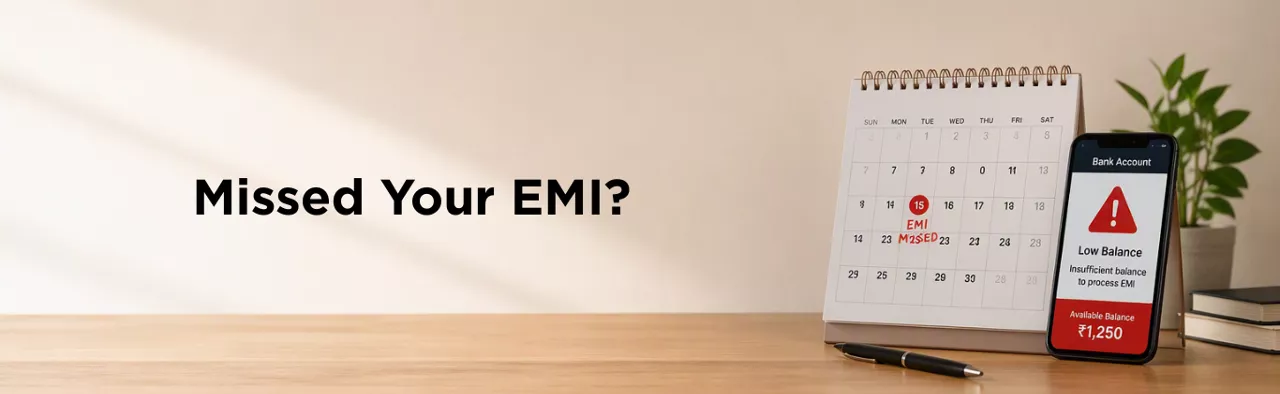
An EMI bounce occurs when a lender's attempt to auto-debit your scheduled EMI from your bank account fails most commonly due to insufficient balance, an expired or incorrectly linked NACH/ECS mandate, or occasionally a technical error between your bank and the lender's system.
What Are EMI Bounce Charges?
EMI bounce charges are penalty fees levied by the lender when a scheduled EMI payment fails to go through. These charges vary by lender and loan type, but for personal loans, they typically range from ₹300 to ₹1,200 per bounce. Public sector banks tend to charge on the lower end, while some NBFCs and private lenders charge higher fees, sometimes structured as a percentage of the overdue amount rather than a flat fee.
Why RBI Regulates These Charges
The Reserve Bank of India mandates that penal charges must be reasonable, transparently disclosed in the loan agreement, and not used purely as a revenue tool. RBI's 2023 guidelines on penal charges also require lenders to communicate a grace period commonly around seven days before reporting a missed EMI to credit bureaus, giving borrowers a short window to rectify the situation.
How an EMI Bounce Affects Your Credit Score
A bounced EMI, once reported to credit bureaus like CIBIL, can lower your credit score by anywhere from 30 to 100 points, depending on your existing credit history and how the bounce is classified. Since payment history carries the highest weight roughly 35% in most credit scoring models, even a single reported bounce can have a meaningful impact, and the record can remain visible on your credit report for several years.
What Happens If You Miss Multiple EMIs
First bounce: You typically receive notifications from the lender and a short grace period to clear the dues.
Repeated bounces Late payment interest and penal charges start compounding, and the lender may begin more frequent follow-up calls.
Persistent default: The lender may classify the account as high-risk, escalate to collection agencies, or in serious cases, initiate legal proceedings under the Negotiable Instruments Act or pursue recovery through a Debt Recovery Tribunal.
How to Avoid EMI Bounce Charges
- Maintain a buffer balance in your linked account 2-3 days before the EMI due date.
- Align your EMI date with your salary credit date, if your lender allows rescheduling.
- Set independent reminders in addition to relying on auto-debit, so you can top up your account manually if needed.
- Verify your NACH/ECS mandate periodically to ensure it hasn't expired or become invalid.
- Communicate proactively with your lender if you foresee a cash flow issue many lenders offer flexibility if you reach out before the due date rather than after a bounce.
Conclusion
Personal loan EMI bounce charges might look like a minor penalty on paper, but the real cost extends well beyond the fee itself a single reported bounce can dent your credit score and make future borrowing more expensive. Maintaining a buffer balance, keeping your mandate details updated, and communicating with your lender proactively are simple habits that can help you avoid the cascade of consequences an EMI bounce can trigger.
Frequently Asked Questions (FAQs)
1. How much are personal loan EMI bounce charges?
They typically range from ₹300 to ₹1,200 per bounce, depending on the lender, with private banks and NBFCs often charging more than public sector banks.
2. Will one EMI bounce seriously damage my credit score?
A single, quickly rectified bounce within the grace period may have limited impact, but if it's reported to credit bureaus as a missed payment, it can lower your score by 30 to 100 points depending on your credit profile.
3. Is there a grace period before an EMI bounce affects my credit score?
Yes, RBI mandates a grace period, typically around seven days, before lenders report a missed EMI to credit bureaus, giving you a short window to clear the payment.
4. Can EMI bounce charges be waived?
In some cases, yes if you explain a genuine one-time reason, such as a salary delay, to your lender, they may waive or reduce the charge, especially for first-time or occasional bounces.
5. What should I do immediately after an EMI bounce?
Fund your account right away and make the payment manually through your lender's app or website rather than waiting for the next auto-debit cycle, to minimise further penalties and credit score impact.

People with similar interests also read: