
Loans
What is Base Rate? Meaning, Impact & How It Affects Loan Interest Rates
3 min read
•
Aug 13, 2026

Introduction
When you take a loan, the interest rate you're offered isn't picked at random it's built on top of a benchmark rate that the bank itself is bound by. One of the earliest such benchmarks used in India was the base rate. Even though most new loans today use newer benchmarks, understanding what the base rate is still matters, especially if you hold an older loan that's still linked to it.
What Is Base Rate?
The base rate is the minimum interest rate that a bank is permitted to lend at the floor below which the bank generally cannot offer loans to customers, regardless of the borrower's profile. Introduced by the Reserve Bank of India (RBI) in July 2010, the base rate replaced the earlier Benchmark Prime Lending Rate (BPLR) system, which lacked transparency and made it hard for borrowers to compare loan offers across banks.
Base Rate = Cost of Funds + Operating Costs + Profit Margin + Regulatory Costs
Each bank calculates and publishes its own base rate there is no single universal base rate set by the RBI for all banks.
How Base Rate Impacts Loan Interest Rates
Most loans priced using this system are quoted as base rate plus a margin for example, base rate + 2%. This means:
- When the base rate rises, loan interest rates linked to it typically rise too, increasing your EMI.
- When the base rate falls, borrowing usually becomes cheaper.
- Because banks revise the base rate infrequently, borrowers on base rate-linked loans often see slower transmission of RBI policy rate changes compared to newer benchmark systems.
For example - on a loan where a small change in the applicable rate say from 9% to 10% occurs, the EMI increase is real but often modest per month; it's the cumulative extra interest paid over the full tenure that adds up.
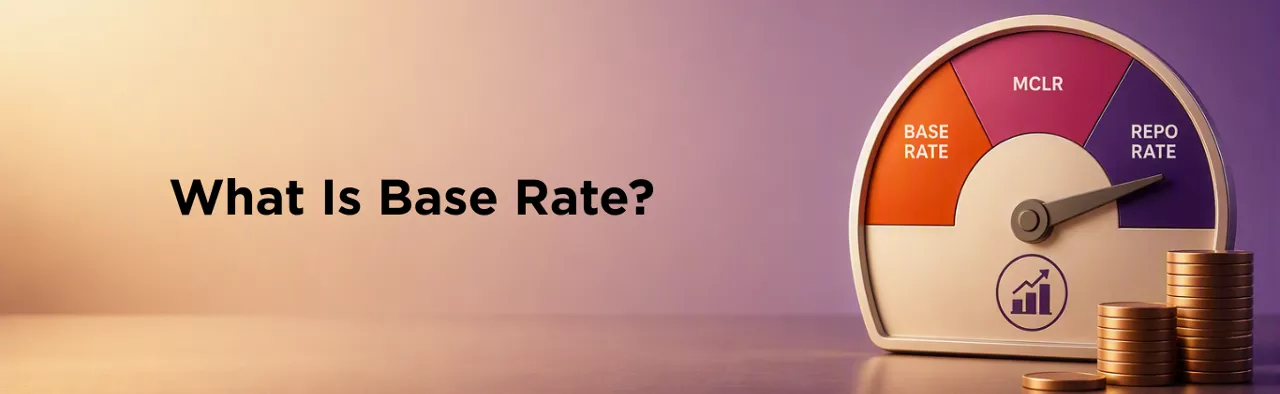
Base Rate vs MCLR vs Repo Linked Lending Rate
The base rate system was replaced by the Marginal Cost of Funds-based Lending Rate (MCLR) for most new loans from April 1, 2016, and later supplemented by repo-linked lending rates for many retail loans.
- Base Rate: Revised infrequently; slower transmission of RBI rate changes.
- MCLR: Reviewed monthly, based on the bank's current cost of funds; faster transmission than base rate.
- Repo-Linked Rate: Directly tied to the RBI's repo rate, offering the most direct and fastest transmission of policy changes to borrowers.
If your loan is still linked to the base rate, you may be paying a rate that hasn't kept pace with more competitive, newer benchmark linked offers in the market it's worth checking whether switching or refinancing makes financial sense for you.
Why the Base Rate System Was Introduced
Before the base rate, banks could lend below the BPLR to select large corporate borrowers while charging retail customers more a practice that made loan pricing opaque and unfair. The base rate system was designed to:
- Ensure no bank lends below a transparent minimum rate.
- Make loan pricing easier for borrowers to compare across banks.
- Help RBI's monetary policy changes reach borrowers, even if with some lag.
- Reduce hidden or unfairly discriminatory loan pricing.
Conclusion
The base rate played an important role in bringing transparency to Indian bank lending, and while it has largely been phased out in favour of MCLR and repo-linked rates, it still affects borrowers with older loans. If you're unsure which benchmark your loan is tied to, checking your loan agreement and comparing it against current MCLR or repo-linked offers is a useful first step toward potentially reducing your interest cost.
Frequently Asked Questions (FAQ’s)
1. Is the base rate still used for new loans in India?
No, most new loans since April 2016 are priced using MCLR or repo-linked rates. The base rate mainly affects older loans that haven't been switched or refinanced.
2. Can I switch my loan from base rate to a newer benchmark?
In many cases, yes banks generally allow borrowers to switch to MCLR or repo-linked rates, sometimes for a nominal conversion fee. It's worth checking with your bank if you're still on a base rate-linked loan.
3. Does the base rate apply to home loans and personal loans equally?
Historically, the base rate was used across loan categories, including home loans, personal loans, and business loans. Today, it primarily remains relevant for legacy loans in these same categories.
4. Who decides the base rate RBI or the bank?
The RBI sets the regulatory framework, but each individual bank calculates and publishes its own base rate based on its cost of funds, operating expenses, and profit margin.
5. How often does a bank change its base rate?
There's no fixed schedule banks typically revise the base rate only when there's a significant shift in funding costs or broader economic conditions, which is why it changes less frequently than MCLR.

People with similar interests also read: