
Safe Banking
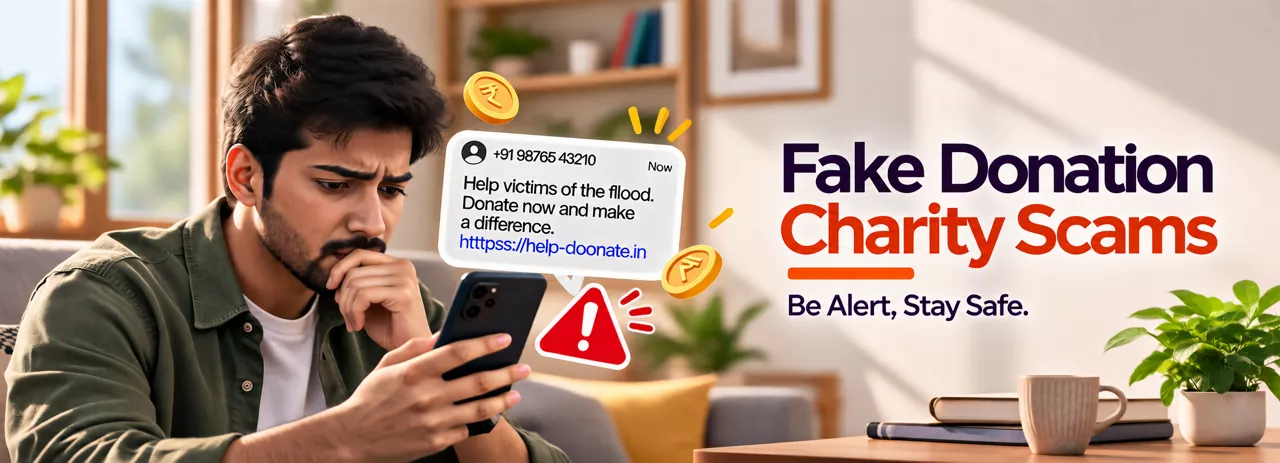
Fake Donation and Charity Scams : How to identify them and donate safely
2 min read
•
Oct 15, 2026

Table of contents
A photo of a child in a hospital bed lands in your family WhatsApp group. A flood has just hit another state and a relief appeal with a QR code is doing the rounds. A temple you visit every year seems to have a new donation link. Indians give generously, and most of these appeals tug at something real. That generosity is exactly what a fake donation scam is built to exploit.
The money you send in these moments rarely reaches a patient, a relief camp or a temple trust. It goes to a fraudster's account, often within minutes, and is moved on before anyone asks questions. The good news is that genuine charities leave a clear trail of registration, receipts and official bank accounts, while fake ones do not. This guide explains how charity fraud works in India, the warning signs, how to check an NGO before you give, and what to do if you have already paid.
What Is a Fake Donation or Charity Scam?
A fake donation scam is a fraud in which a person or group poses as a charity, relief fund, temple trust or someone in medical need to collect money that is never used for that cause. The appeal usually arrives through WhatsApp, SMS, social media or a door-to-door collector, and asks you to pay quickly through a personal UPI ID, QR code or payment link.
Some fraudsters invent a cause from scratch. Others copy the name, logo and photos of a real, registered organisation and swap in their own payment details. Both rely on the emotional pull of the cause and the speed of digital payments.
How Does a Charity Scam Work? Step by Step
- Pick a trigger. Fraudsters time their appeals around news that moves people: a natural disaster, a temple consecration, a festival or a viral story of a sick child.
- Build a convincing story. They lift real photos from news reports or social media, forge hospital estimates or copy a known NGO's branding.
- Spread it widely. The appeal travels through WhatsApp forwards, social media posts, SMS, cold calls and even printed QR posters near religious places.
- Create urgency. Messages say "surgery is tomorrow", "only a few hours left" or "every minute counts", so you pay before checking.
- Collect money through untraceable channels. Payment is requested to a personal UPI ID, a QR code, a payment link, a crypto wallet or in cash, never to the organisation's own verified bank account.
- Disappear or repeat. Once the money arrives, it is moved through other accounts, the profile is deleted or the campaign is reposted under a new name.
Common Types of Donation Fraud in India
Fake NGO and relief fund appeals
After floods, earthquakes or other disasters, appeals for "victims" appear with a UPI ID that looks official, sometimes mimicking a government relief fund with a similar-sounding handle. Genuine relief funds and NGOs publish payment details only on their own official websites.
Fake crowdfunding for medical emergencies
In fake medical fundraisers, the photos belong to someone else, the hospital has never heard of the patient, or the organiser is a stranger who raises money in a real patient's name without the family knowing. Warning signs include a target that keeps rising, no hospital billing details, and organisers who block anyone asking questions.
Temple and religious donation QR codes
Fraudsters place fake QR codes near temples, gurdwaras, churches and pilgrimage sites, or circulate them online around big religious events. Some paste their own QR sticker over the original one. Others send "donate for the temple" or "book special darshan" links that lead to fake websites or install harmful apps.
Fake tax-saving receipt promises
Some callers promise a tax deduction or a "tax-free receipt" to make the appeal look legitimate. Only donations to organisations approved by the Income Tax Department qualify, and the deduction is available only to taxpayers who choose the old tax regime. A genuine organisation reports your donation to the department so it reflects under your PAN. A fake receipt gives you no tax benefit and can cause trouble if you claim it.
Door-to-door and street collectors
Collectors with printed ID cards, receipt books and donation boxes visit homes, offices and traffic signals. These are easy to fake. Real organisations can always tell you how to donate through their official website or bank account.
Social media fundraisers and impersonation
Fake pages copy the name and posts of a real charity, or hack and misuse a friend's account to send a personal plea. The message often says "please send to this UPI ID, the bank account is not working" to steer you away from the official channel.
Genuine Charity vs Fake Donation Appeal: Key Differences
What to check | Genuine charity | Fake donation appeal |
Registration | Can share its registration details, PAN and NGO Darpan Unique ID, which you can verify yourself | Avoids sharing details or gives numbers that do not match any record |
Payment channel | Organisation's own bank account or the payment page on its official website | Personal UPI ID, individual's account, random QR code, crypto or cash |
Name on payment | UPI or account name matches the registered organisation | Name of an individual or an unrelated business appears at payment |
Urgency | Gives you time and welcomes questions | Pushes you to pay in minutes, blocks or ignores questions |
Receipt | Issues a proper receipt with registration details | No receipt, a screenshot "receipt" or a vague promise of a tax benefit |
Proof of work | Publishes reports and can share details of where funds go | Shares only emotional photos and stories, no verifiable details |
Contact | Fixed address, official website and helpline | Only a mobile number or social media profile |
Red Flags to Watch For Before You Donate
- The appeal reaches you unasked, through a forward, cold call or unknown number.
- You are asked to pay to a personal UPI ID, scan a QR code shared on chat, or click a payment link.
- You receive a UPI collect request to "donate". A charity cannot pull money from your account without your UPI PIN.
- The payee name on the UPI screen is an individual or a name unrelated to the charity.
- The story has gaps: no hospital name, no patient name, no address, or details that change from one post to another.
- Pressure tactics such as "last chance", "life or death in an hour" or guilt-laden language.
- Requests for OTP, card details, UPI PIN or remote screen-sharing apps "to process the donation".
- A request to install an app or APK file to make a donation or claim a receipt.
- Promises of a tax benefit, prize or lucky draw in return for your donation.
If any of these appear, pause. A real cause will still be there after you have checked it.
How to Verify a Genuine Charity or NGO in India
- Ask for registration details. A genuine Indian charity is registered as a trust, society or Section 8 company. Ask for its registration number, PAN and NGO Darpan Unique ID, the identification given to voluntary organisations by the Government of India's NGO Darpan portal.
- Check its tax registrations. Charities that offer tax-saving receipts must hold registration with the Income Tax Department for tax exemption and an approval that allows donors to claim a deduction. These are widely known by their older section names, 12A and 80G. Ask for the approval details and check that they are current.
- Visit the official website yourself. Search for the charity yourself rather than clicking a forwarded link, and compare the payment details on the official site with the ones you were sent.
- Confirm the payee name. When you enter a UPI ID or scan a QR code, the name of the receiver appears before you pay. It should match the registered name of the organisation, not a person.
- For medical fundraisers, verify with the hospital. Call the hospital's official number, check that the patient is admitted, and where possible pay the hospital directly against the bill.
- Look for a track record. Annual reports, audited accounts, field projects and a long public history are signs of a real organisation.
- Ask for a proper receipt. Insist on a receipt carrying the organisation's name, address, PAN and registration details. If you want a tax deduction, the organisation must report your donation to the Income Tax Department.
Paying the right way
- Pay only into the organisation's own bank account or through the payment page on its official website.
- Never pay to a personal UPI ID, an individual's account, a forwarded QR code or a collect request you did not start.
- Avoid cash for large amounts. Cash donations above a small limit do not qualify for a tax deduction anyway, and cash leaves no trail.
- Read our guide on how to safely make QR code payments before scanning any code in public places.
What to Do If You Have Paid a Fake Charity
Act quickly. The sooner a fraud is reported, the better the chance of stopping the money from moving further.
- Call the national cybercrime helpline 1930 and register a complaint, or file one online at cybercrime.gov.in. Share the UPI ID, transaction reference number, date, time and screenshots.
- Inform your bank right away. AU Small Finance Bank customers can call the toll-free numbers 1800 1200 1200 or 1800 26 66677. You can also open the transaction in the AU 0101 App, tap the three dots and choose the report fraud option. The full list of channels is on the report unauthorised transactions page.
- Secure your accounts. If you shared an OTP, card details or UPI PIN, or installed an app at the fraudster's request, block your card, change your PIN and passwords, and uninstall the unknown app.
- Report the profile or number. Report the fake page or fundraiser on the social media platform or crowdfunding site, and report the fraud call or message through Chakshu on the Sanchar Saathi portal.
- Keep records. Save chats, call logs, payment screenshots and the fake receipt. These help the police and your bank.
How to Keep Your Family Safe From Donation Fraud
Fraudsters often target older family members who are active on WhatsApp groups and generous with religious and medical causes.
- Agree on a family rule: no donation through a forwarded link or personal UPI ID, ever.
- Show elders how the payee name appears on the UPI screen before they pay.
- Turn on transaction alerts and set sensible limits on cards and UPI through your banking app.
- Read up on related tricks such as social engineering fraud, fake job offer scams and suspicious apps and APK files. An appeal that promises returns on your "contribution" is an investment scam, not a charity.
Conclusion
A fake donation scam works only when kindness meets urgency. Slow down, check the registration, confirm the payee name, and pay only through the organisation's own official channel. A genuine charity will always welcome those questions.
If something does go wrong, speed matters. Call 1930, and contact AU Small Finance Bank on its toll-free helpline or report the transaction through the AU 0101 App, where you can also block cards, set limits and track every payment from one place.
Frequently Asked Questions (FAQs)
How do I know if a charity is fake in India?
Ask for its registration number, PAN and NGO Darpan Unique ID, check them against official records, and compare payment details with its official website. If the appeal asks you to pay to a personal UPI ID, uses heavy pressure or cannot give a proper receipt, treat it as fake.
Is it safe to donate through a QR code?
It is safe only when the QR code is on the organisation's official website or displayed by its management at its own premises. Before paying, check that the payee name on your screen matches the registered organisation. Never scan a QR code sent by a stranger on chat or social media.
Can a fake charity give me an 80G receipt?
A fraudster can print an official-looking receipt, but it will not give you a tax deduction. Only donations to organisations approved by the Income Tax Department qualify, and the organisation must report your donation so it shows up in your tax records. Always verify the approval before relying on a receipt.
What should I do if I donated to a fake fundraiser?
Call the national cybercrime helpline 1930 or file a complaint at cybercrime.gov.in, and inform your bank immediately. AU Small Finance Bank customers can call 1800 1200 1200 or report the transaction in the AU 0101 App. Keep screenshots of the appeal, chats and payment details.
Are crowdfunding campaigns for medical treatment genuine?
Many are genuine, but some are fake or run without the patient's knowledge. Call the hospital to confirm the admission, check the organiser's link to the patient, and where possible pay the hospital directly.
Why do scammers ask for donations through a personal UPI ID?
A personal UPI ID lets the money reach the fraudster instantly and be moved on quickly. Genuine organisations collect donations in their own registered name, so an individual's name at payment is a reason to stop.
Do I need to enter my UPI PIN to donate?
You enter your UPI PIN only when you are sending money that you chose to send. If you receive a collect request you did not expect, decline it. Never share your UPI PIN, OTP or card details with anyone collecting a donation.
Are door-to-door donation collectors genuine?
Some are, but ID cards and receipt books are easy to fake. Look up the organisation yourself and donate through its official website or bank account rather than handing over cash.
To report cyber fraud, call 1930 or visit: https://cybercrime.gov.in/home

People with similar interests also read: